
| Engineering Insights | Protec Pacific Team
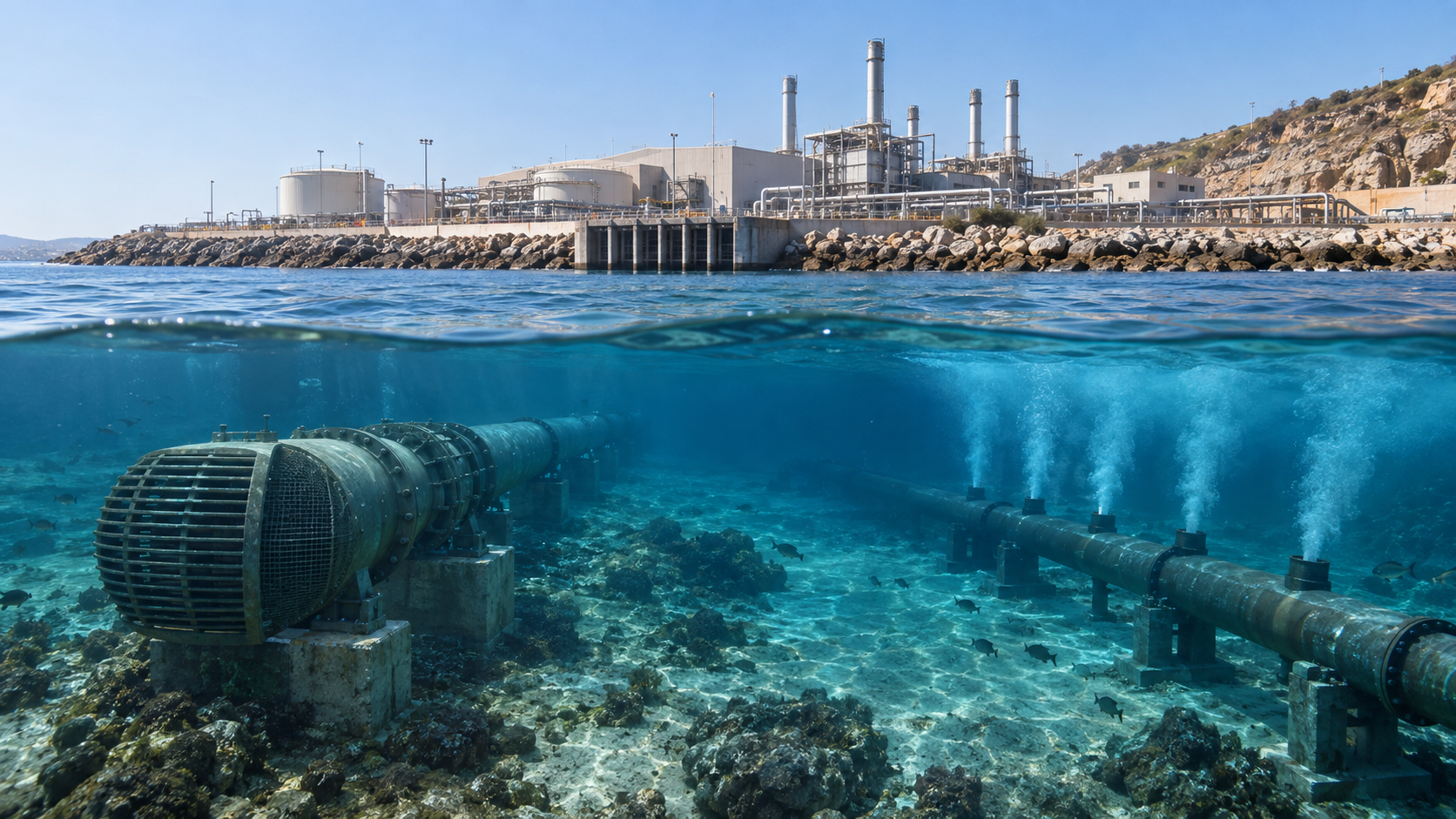
Seawater intake and marine outfall systems form critical interfaces between coastal facilities and the receiving environment. In desalination, power, petrochemical, industrial and municipal applications, poor design can contribute to debris loading, biofouling, hydraulic restrictions, corrosion, excessive maintenance and environmental compliance risks. A reliable system therefore begins with a site-specific understanding of marine conditions and integrates hydraulics, materials, constructability, operability and environmental requirements from the outset.
Intake design starts with site conditions
Every coastal site presents a different combination of bathymetry, tides, waves, currents, sediment transport, marine growth and seasonal water-quality variation. These conditions influence intake location, intake configuration, screening requirements, pipeline routing, and the duty of downstream pretreatment systems.
Site surveys, bathymetric information, marine and environmental data, and representative water-quality records should therefore be evaluated before the intake concept is finalized. Intake velocity and screen configuration also require careful assessment to control hydraulic losses, debris loading, and the potential impingement or entrainment of marine organisms.
Hydraulics and screening must work together
The intake structure, screen system, pipeline and pumping arrangement should be designed as one hydraulic system. Pipe diameter, flow velocity, head loss, suction conditions, and transient behavior all influence reliability. Screening equipment must also be accessible for inspection and cleaning, with an operating philosophy that can manage debris and marine growth without compromising plant availability.
Outfall design combines hydraulics with environmental performance
A marine outfall is not simply a discharge pipe. Diffuser configuration, port size and orientation, discharge velocity, initial dilution and plume behaviour must be evaluated together with ambient currents, stratification, background water quality and the applicable discharge criteria.
Where required, hydrodynamic and dilution modelling should be used to demonstrate that the selected outfall arrangement provides suitable dispersion under relevant operating and environmental conditions. Monitoring and sampling provisions should also be incorporated so that performance can be verified during operation.
Materials matter more in marine conditions
Marine exposure places demanding requirements on materials. HDPE, GRP/FRP, appropriately protected carbon steel, stainless steel for suitable services, and reinforced concrete designed for chloride exposure may all have a role depending on the application. Selection should consider corrosion, abrasion, UV exposure, biofouling, installation method, maintainability, and whole-life cost rather than initial cost alone.
Design for inspection, maintenance and long-term reliability
A reliable intake and outfall system should be designed with its future inspection and maintenance requirements in mind. Access points, isolation philosophy, screen maintenance, inspection methods, replaceable components and provisions for cleaning should be considered during design so that maintenance can be performed safely and with minimum interruption to the facility.
Protec Pacific Engineering Support
Protec Pacific supports the engineering and integration of seawater intake and marine outfall systems from initial site assessment and concept development through detailed design, equipment integration, installation support and commissioning.